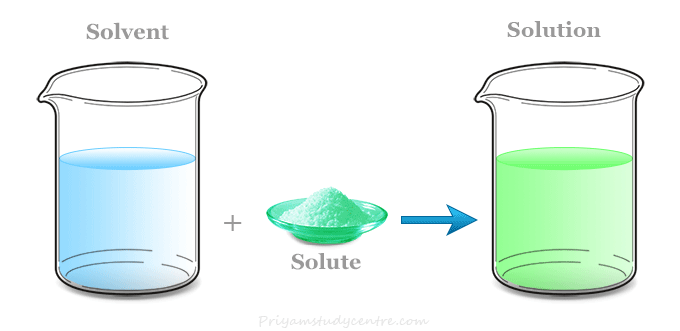
In chemistry, a solution is described by the IUPAC as “a liquid or solid phase that contains more than one substance, where one (or more) substance, which is referred to as the solvent, is treated differently from the other substances, known as solutes.When, as is often but not always the case, the total mole fraction of solutes is much smaller than one, the solution is classified as a dilute solution.” One important characteristic of a solution is concentration, which refers to the quantity of solute present in a specific amount of solution or solvent.The term “aqueous solution” is used when water is one of the solvents involved.
Types of Solutions:
Types of solutions can be categorized as homogeneous or heterogeneous. A homogeneous solution consists of components that form a single phase, whereas a heterogeneous solution contains components that exist in different phases. The properties of the mixture, such as concentration, temperature, and density, can be evenly spread throughout the volume, but only in the absence of diffusion or after the diffusion process has completed. Typically, the substance that is present in the largest amount is considered the solvent. Solvents can exist in the form of gases, liquids, or solids. Any components of the solution other than the solvent are referred to as solutes. The solution itself will have the same physical state as the solvent.
Mixtures of gasses :
- Only gases (non-condensable) or vapors (condensable) dissolve in a given set of conditions if the solvent is a gas.
- Air (oxygen and other gases dissolved in nitrogen) is an example of a gaseous solution.
- Non-condensable gases create fairly minor solutions because interactions between gaseous molecules are essentially insignificant.
- They are merely referred to as homogeneous mixes of gases in the literature rather than being categorized as solutions.
- The homogeneity of gaseous systems is ensured by Brownian motion and the ongoing molecular agitation of gas molecules.
- Neither sediment nor non-condensable gaseous mixtures (such as air/CO₂ or air/xenon) spontaneously demix and separate into gas layers according to their relative densities.
- Under typical Earthly conditions, diffusion forces effectively oppose gravitational forces.
- In contrast, surplus vapor condenses into the liquid state when the saturation vapor pressure at a particular temperature is reached in the case of condensable vapors.
- Solutions in liquid form: Gases, other liquids, and solids are all dissolved by liquids.
- Fish can breathe underwater thanks to oxygen, which is an example of a dissolved gas.
- Ethanol in water, which is present in alcoholic beverages, is an example of a dissolved liquid.
- Sugar water, which has dissolved sucrose, is an illustration of a dissolved solid.
- Solid solutions: Gases, liquids, and solids can all be dissolved if the solvent is a solid.
- Metals, particularly palladium, dissolve hydrogen quite effectively; this is being researched as a way to store hydrogen.
- Mercury in gold is an example of a liquid dissolved in a solid.
Solvation and Solubility:
Solubility is the capacity of one substance to dissolve in another. Two liquids are said to be miscible when one can totally dissolve in the other. Immiscible compounds are those that never combine to produce a solution.
The entropy of mixing is positive for every solution. It is possible for interactions between various molecules or ions to be energetically favored or not. The free energy drops as the concentration of the solute increases if interactions are unfavorable. The solution is said to be saturated when the energy loss exceeds the entropy gain and no more solute particles [clarification needed] can be dissolved. However, a solution’s saturation point can vary greatly depending on a number of external conditions, including temperature, pressure, and pollution. A supersaturated solution can be made for some solute-solvent combinations by increasing the solubility (by rising the temperature, for example) to dissolve more solute and subsequently decreasing it (by cooling, for example).
Generally speaking, a solvent can dissolve more of a certain solid solute at higher temperatures. However, the solubilities of the majority of gasses and certain chemicals decrease as the temperature rises. An exothermic enthalpy of solution is the cause of this phenomenon. This behavior is displayed by certain surfactants. Compared to solids or gasses, the solubility of liquids in liquids is often less sensitive to temperature.
 Nafeesa
Leave a comment