Definition: Anticipatory socialisation is the method of studying and practicing the values, norms, and behaviors of a group or role before absolutely coming into it. This guidance helps humans adapt greater easily to future transitions.
Origins: The idea used to be delivered with the aid of sociologist Robert K. Merton to explain how persons modify to anticipated social roles. It highlights how learning starts offevolved earlier than formal membership.
Examples: Common instances consist of college students taking internships, recruits coaching earlier than military service, or immigrants studying about a new culture earlier than moving. These practices minimize uncertainty and construct readiness.
Functions: Anticipatory socialisation eases position adjustments by means of providing knowledge, skills, and expectations in advance. It additionally fosters identity development and self assurance in new settings.
Limitations: Not all expectations in shape reality, which can lead to stress or disappointment. Over-preparation might also also toughen stereotypes or unrealistic assumptions.

Purpose And Function
The predominant reason of anticipatory socialisation is to reduce uncertainty and ease the transition into new roles.
By gaining knowledge of expectations in advance, men and women achieve the knowledge, skills, and confidence wished to navigate unfamiliar situations.
This practise makes role modifications – such as starting a new job, coming into a relationship, or adjusting to parenthood – less annoying and more manageable.
Anticipatory socialisation additionally helps identity development, as human beings begin to see themselves in terms of future roles and adapt their behaviour accordingly.
Examples
Internships and Work Experience: Students take internships, part-time jobs, or volunteer positions to practice the norms and skills of their future careers.
Education to Employment: High college or university college students can also gown more formally, network, or undertake professional behaviours as they prepare to enter the workforce.
Parenthood Preparation: Expectant parents may additionally examine parenting books, attend classes, or set up a nursery in strengthen of the child’s arrival.
Retirement Planning: Adults prepare for later lifestyles by way of saving money, discovering healthcare, and imagining new roles backyard of work.
Cultural Transitions: Immigrants may also examine a new language, find out about cultural customs, or be a part of community businesses earlier than transferring to every other country.
Theories And Origins
The idea of anticipatory socialisation used to be first delivered via sociologist Robert K. Merton in the 1940s.
Merton determined that human beings regularly start to adopt the attitudes, values, and behaviours of companies they aspire to join, even before they gain formal membership.
This idea fits within the broader framework of socialisation theory, which explains how folks research and internalise the norms and expectations of society.
By highlighting the ways human beings “rehearse” future roles, Merton confirmed that socialisation is not restrained to childhood but is an ongoing manner that prepares folks for new statuses for the duration of life.
Anticipatory socialization has two parts:
vocational anticipatory socialization (VOS), and
organizational anticipatory socialization (OAS) (Jablin, 2001).
Vocational anticipatory socialization refers to how humans socialize, and enhance a perception of the competencies needed for a job, which can begin in childhood. For example, a baby whose father is a trainer builds and concept of the profession, supplemented with the aid of how instructors are depicted in movies.
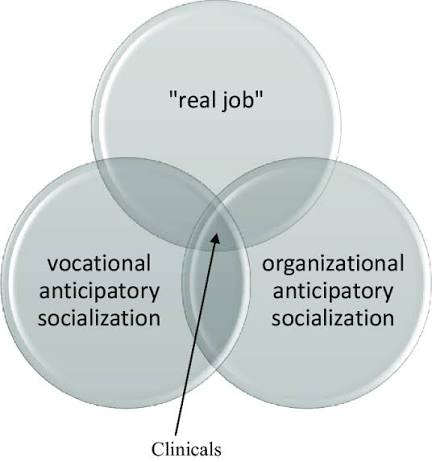
Organizational anticipatory socialization is when skilled humans take a step in the direction of obtaining the norms and values of their chosen profession by, for example, taking part in an intern program.
Conclusion
Anticipatory socialization is a technique that men and women voluntarily undergo in order to prepare for a new role that they choose to do, or to be part of a new group. It includes studying about the values, norms and behaviors needed to be a part of a new group or operate a role.
Anticipatory socialization eases the transition into a new role and additionally helps adjusting to it. There are a number of sources of anticipatory socialization, such as: family, educational institutions, media, friends and friends, and part-time employment.
Anticipatory socialization can begin as early as childhood, regarded as vocational anticipatory socialization (VOS) or later in life, recognised as organizational anticipatory socialization (OAS).
 Nafeesa
Leave a comment