Electrochemical reactions de carried out in gadgets called electrochemical cells, which couple the oxidation-reduction reactions to external electrical circuits. Elec- trochemical cells have the captivating characteristic that the oxidizing reactant can be phys- ically separate from the reducing reactant as long as they are linked thru the external circuit. If the reaction is spontaneous, the phone makes use of the Gibbs free power reachable from the response to convert chemical electricity into electrical energy. The electrical strength is provided to the exterior circuit, where it can operate beneficial work. This type of cellphone is referred to as galvanic. Electrolytic cells function in the contrary sense; they take electrical strength from the external circuit and use it to power reac- tions that are not spontaneous. In each cases the path and magnitude of modern-day waft in the external circuit are governed by way of the Gibbs free electricity exchange of the oxidation-reduction response in the cell.
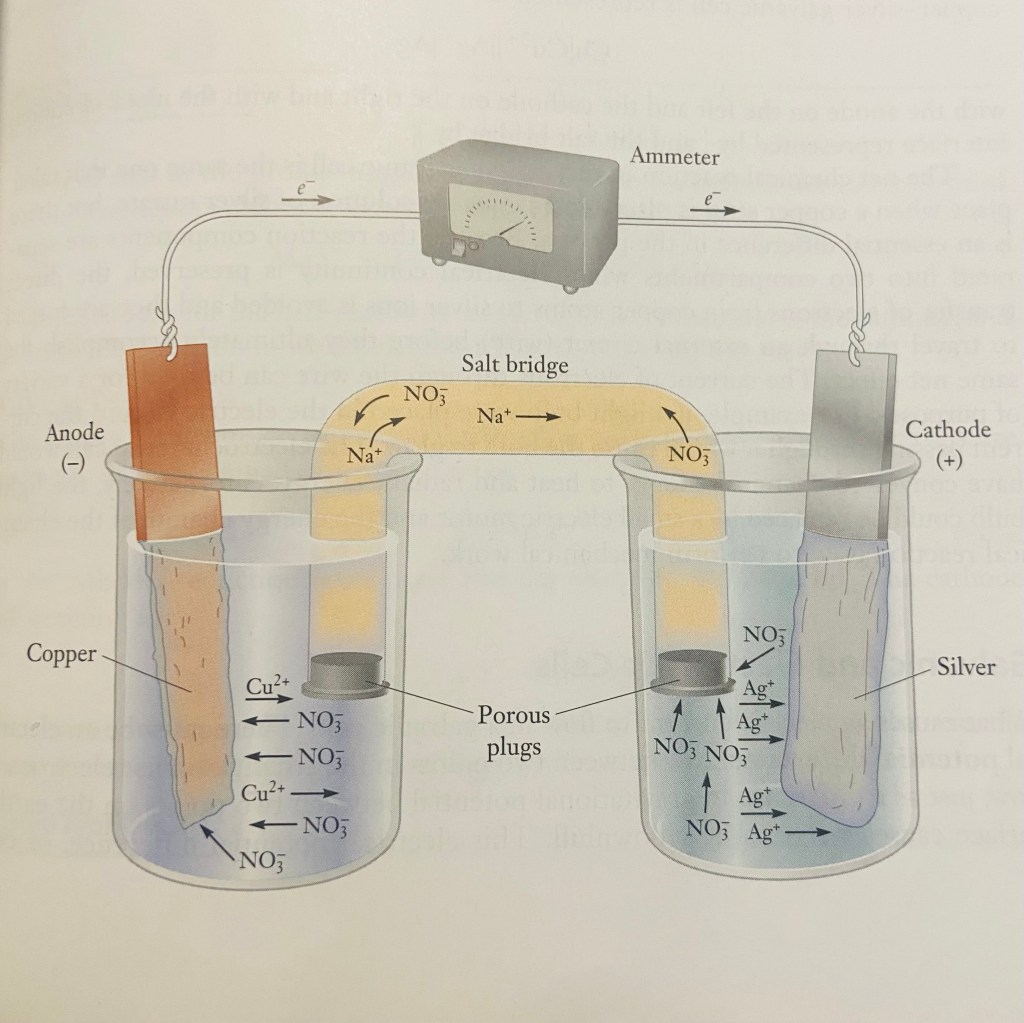
Using an electrochemical mobile phones as an alternative capacity to raise out an oxidation- reduction reaction is illustrated with the aid of the reaction of copper with aqueous silver ions shown in Figure which is certainly spontaneous. This same response can be carried out quite otherwise barring ever bringing the two reactants into direct contact with each other if a galvanic mobile (a battery) is built from them. A copper strip is partly immersed in a solution of Cu(NO3)2 and a silver strip in a solution of AgNO3,
salt bridge, which is an inverted U-shaped tube containing a solution of a salt such as NaNO2. The ends of the bridge are stuffed with porous plugs that prevent the two solutions from mixing but allow ions to omit through. The two metallic strips are linked to an ammeter, an instrument that measures the path and magnitude of electric cutting-edge thru it.
electrons released in the response pass by through the exterior circuit from left to proper As copper is oxidized on the left side. Cu2+ ions enter the solution. The elec. as shown by means of the deflection of the ammeter needle. The electrons enter the silver plate out as atoms on the floor of the silver. This procedure would lead to an in- strip, and at the metal-solution interface, they are picked up by using Ag ions, which crease of tremendous charge in the left beaker and a reduce in the right one had been it not for the salt bridge; the bridge allows a internet go with the flow of effective ions via it into the proper beaker and of bad ions into the left beaker, retaining charge neu- trality in each.
As discussed this oxidation-reduction reaction is composed of two separate half-reactions. The oxidation half-reaction in the left-hand beaker is Cu(s) Cu2+(aq) + two e give up the reduction half-reaction in the proper beaker is Ag+(aq) +eAg(s)
Foliowing Michael Faraday, chemists name the site at which oxidation occurs in an Mectrochemical phone the anode and the website online at which reduction occurs the cathode. in the galvanic mobile just discussed, copper is the anode (because it is oxidized) and sil-
fer is the cathode (because Ag+ is reduced). Electrons go with the flow in the exterior circuit from anode to cathode. In answer each fine and negative ions are free to move. In an electrochemical cell, negative ions (anions) pass toward the anode and posi- tive ions (cations) pass toward the cathode. We will undertake a conference for galvanic cells in which the anode is proven on the left and the cathode on the right so that electrons flow through the exterior circuit from left to right. Schematically the copper-silver galvanic telephone is represented as
with the anode on the left and the cathode on the proper and with the metal-solution interface represented by | and the salt bridge via ||.
The internet chemical reaction in this easy galvanic mobile is the same one that takes place when a copper strip is placed in an aqueous answer of silver nitrate, however there is an fundamental distinction in the process. Because the reaction elements are sepa- rated into two compartments whilst electrical continuity is preserved, the direct switch of electrons from copper atoms to silver ions is prevented and they are pressured to tour through an external circuit (wire) earlier than they ultimately accomplish the equal net effect. The current of electrons via the wire can be used for a range of purposes. For example, if a mild bulb have been placed in the electric powered circuit, the cur- lease passing thru it would motive the bulb to glow. The electrochemical cellphone would have converted chemical strength to heat and radiant energy. Alternatively, the light bulb ought to be changed through a small electric powered motor and the power exchange of the chem- ical reaction used to function mechanical work.
Galvanic and Electrolytic Cells:
What reasons an electric powered current to drift in a galvanic cell? There have to be an electri- cal attainable difference, A8, between two points in the circuit to reason electrons to flow, just as a distinction in gravitational potential between two points on the earth’s surface reasons water to drift downhill. This electrical workable difference, or cellphone on the magnitude of voltage, can be measured with an instrument known as a voltmeter inserted in the ex- rernal circuit. The voltage measured in a galvanic telephone relies upon the present day passing via the cell, and the voltage falls if the contemporary turns into too large. The intrinsic mobile voltage (the fee at zero current) can be measured by plac- ing a variable voltage source in the exterior circuit in such a way that its viable distinction &ext opposes the intrinsic possible difference 4% of the electrochemical cell. The net doable difference is then
Anet = ΔΕ Δ&ext
18 can be measured by means of adjusting A&ext until Anet becomes 0, at which point the modern-day through the ciruit falls to O as well. If A&ext is held just beneath A8, the net manageable difference will become small and the telephone operation is close to reversible, with only a small present day and a slow charge of reaction at the electrodes.
If the opposing external voltage is improved above the natural possible differ- ence of the cell, the electrons reverse direction and go towards the copper elec- trode. Copper ions in answer take delivery of electrons and savings as copper metal, and sil- ver metallic dissolves and furnishes extra Ag+ ions. The net response occurring is then the reverse of the spontaneous reaction, namely,
2 Ag(s) + Cu²+(aq) →2 Ag+ + Cu(s)
A galvanic (or voltaic) cell is an electrochemical phone that operates sponta- neously. Such a cell converts chemical energy to electrical energy, which can be used to function work. A telephone in which an opposing external plausible causes the re- motion to occur in the route contrary the spontaneous path is referred to as an elec- trolytic cell; such a cell uses electrical energy supplied by means of the exterior circuit to elevate out chemical reactions that would in any other case now not occur. When a mobilephone is modified into an electrolytic cellphone by the addition of an external achievable supply that reverses the path of electron flow, there is also a reversal in the websites of the anode and the cathode. In the electrolytic cell, oxidation takes place at the silver electrode, which therefore turns into the anode, and the copper electrode turns into th cathode.
 Nafeesa
Leave a comment