Gas chromatography (GC) is an analytical method used to separate, identify, and measure the individual substances that make up a mixture. It has become a cornerstone technique across many industries because of its ability to break down complex chemical samples into their component parts.
This overview walks through how GC works, the equipment involved, the types of columns and carrier gases available, and how samples are prepared and injected. It also covers detector types, how chromatogram data is read and interpreted, common real-world applications, the technique’s strengths, typical troubleshooting issues, and its pairing with mass spectrometry. Finally, it touches on quantitative and qualitative analysis methods and a few specialized GC variations.
How Gas Chromatography Works
At its core, GC exploits the fact that different molecules interact with a stationary surface (either liquid or solid) to different degrees while being carried along by a moving gas. A sample is vaporized and swept by an inert carrier gas through a narrow column. As the sample’s components pass through, each one interacts with the stationary material inside the column in its own way, causing them to travel at different speeds and exit the column at different times — a measurement known as retention time.
How strongly a given compound interacts with the stationary phase — and therefore how it separates from the rest of the mixture — depends on the chemistry of that stationary phase as well as characteristics of the compound itself, such as boiling point and polarity.
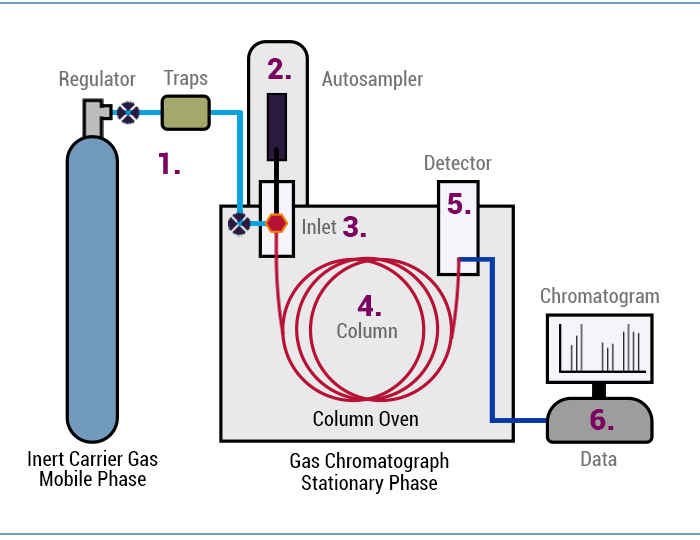
Key Parts of a Gas Chromatograph
A GC instrument is built from several components, each with a distinct job:
- Injector – vaporizes the sample and feeds it into the carrier gas stream heading into the column.
- Column – contains the stationary phase and is where separation actually happens; columns are either packed or capillary.
- Detector – tracks the individual compounds as they exit (elute from) the column.
- Carrier gas system – supplies a steady stream of gas (typically helium, nitrogen, or hydrogen) to move the sample through the column.
- Oven – houses the column and controls its temperature.
- Data system – most modern instruments include software that runs the instrument and records results automatically.
Column Types
There are two broad categories of GC columns, and the choice between them shapes how well components separate.
Packed columns are filled with finely divided solid material that serves as the stationary phase. They have a wider bore, are physically sturdier, and are well-suited to situations that call for high sample capacity. A related technique, flash chromatography, also relies on packed-column principles and is frequently used in food science and pharmaceuticals to rapidly purify active compounds from natural sources.
Capillary columns, also known as open tubular columns, are narrow inert tubes lined internally with a liquid stationary phase. They deliver sharper resolution and greater efficiency than packed columns, which is why they dominate modern GC work.
Carrier Gases
Helium, nitrogen, and hydrogen are the three gases commonly used to carry the sample through the column. Which one is chosen depends on the detector in use, the level of efficiency needed, cost considerations, and safety.
| Property | Nitrogen | Helium | Hydrogen |
|---|---|---|---|
| Availability | High | Medium | Medium |
| Flammability | Non-flammable | Non-flammable | Flammable |
| Cost | Low | Medium | High |
| Penetration into stationary phase | Moderate | Good | Excellent |
| Sample resolution | Fair | Good | Excellent |
| Detector compatibility | Good | Excellent | Excellent |
Preparing Samples
Getting reliable results starts with proper sample prep. Common approaches include:
- Liquid-liquid extraction – pulls the compound of interest out of the surrounding sample matrix.
- Solid-phase extraction – concentrates the sample using a solid adsorbent material.
- Headspace sampling – geared toward analyzing volatile compounds.
- Derivatization – chemically converts the sample into a form that’s easier to analyze on a GC system.
How Samples Get Injected
The way a sample enters the column can meaningfully affect the outcome. The three most widely used injection approaches are:
- Split injection – only a portion of the vaporized sample enters the column; the rest is vented away.
- Splitless injection – functions similarly, except the entire sample is directed into the column rather than partially discarded.
- On-column injection – the sample is placed directly onto the column, then heated and vaporized there; this is the preferred approach for samples that break down easily under heat.
Detector Types
Detectors identify the compounds as they leave the column. Which detector is used depends on the target analyte and the type of information needed.
- Flame Ionization Detector (FID) – widely used for hydrocarbons and known for its high sensitivity.
- Electron Capture Detector (ECD) – very sensitive and particularly good at picking up halogenated compounds found in environmental samples.
- Thermal Conductivity Detector (TCD) – valued for being a reliable, general-purpose detector.
- Mass Spectrometer – adds compound-identification power on top of detection and is especially useful for quantitative work.
Reading and Interpreting Chromatograms
A chromatogram plots the detector’s signal over time, and reading one accurately used to be a slow, manual process. Today’s software handles most of the heavy lifting, but the underlying steps remain:
- Peak identification – peaks are matched to compounds based on retention time; when retention time alone isn’t conclusive, mass spectral data can fill the gap.
- Quantification – the amount of a given compound is calculated either from the area under its peak or from the peak’s height.
- Resolution assessment – checks how cleanly two neighboring peaks are separated from one another.
Where Gas Chromatography Is Used
GC’s versatility means it shows up across a wide swath of industries:
- Environmental monitoring – tracking and quantifying pollutants.
- Pharmaceuticals – verifying the quality and purity of drug substances.
- Food and beverage – authenticating products and confirming quality.
- Petrochemicals – separating and characterizing hydrocarbon mixtures.
- Forensic science – identifying drugs and toxic substances.
Why Use Gas Chromatography
GC’s popularity comes down to several practical advantages: it can detect very small quantities of an analyte, separate even highly complex mixtures with strong resolution, and adapt to a huge range of applications. It’s also relatively fast, generally needs only modest sample prep, and lends itself well to automation — which cuts down on manual error.
Common Problems and Their Causes
Even a well-run GC system can run into a handful of recurring issues, most of which trace back to what’s happening inside the column:
- Peak tailing – the trailing edge of a peak stretches out, distorting its shape and hurting accuracy.
- Ghost peaks – unexpected extra peaks caused by leftover sample residue or a contaminated column.
- Poor resolution – peaks aren’t cleanly separated, which muddies interpretation and reduces accuracy.
- Retention time shifts – small changes in operating conditions cause retention times to drift.
Pairing GC with Mass Spectrometry (GC-MS)
Combining GC with mass spectrometry adds a powerful identification layer on top of standard separation, giving analysts much greater confidence in their results. GC-MS not only helps pin down unknown compounds but also supports quantitative work by tracking specific ions of interest, making it a flexible tool used across many fields.
Measuring How Much: Quantitative Analysis
Quantitative GC analysis is about figuring out how much of a target compound is present. The most common approach uses calibration standards, relying on the fact that detector response scales linearly with concentration. Other methods include:
- Internal standards – a known quantity of a reference compound is added to the sample to help calculate the unknown amount.
- Standard addition – another technique for pinning down an unknown concentration.
Identifying Compounds: Qualitative Analysis
Qualitative GC work focuses on figuring out what is in a sample, using a mix of approaches:
- Retention index comparison – matches an unknown compound’s retention behavior against known reference values.
- Mass spectral matching – compares a compound’s mass spectrum against a reference library, especially useful for unidentified organic compounds.
- Chemical derivatization – alters a compound’s functional groups to shift its retention behavior in ways that aid identification.
Specialized GC Techniques
A few variations on standard GC have been developed to boost speed, efficiency, or separating power:
- Fast GC – uses short columns and steep temperature ramps to cut analysis time dramatically.
- Multidimensional GC – uses more than one column in sequence to untangle especially complex mixtures.
- Chiral separations – designed to separate enantiomers (mirror-image molecules), which matters a great deal in pharmaceutical development.
Frequently Asked Questions
What is the underlying principle of gas chromatography?
Compounds are separated based on how differently they partition between the moving gas phase and the stationary phase in the column. Substances that interact more strongly with the stationary phase move through more slowly; those that interact less strongly move through faster — producing separation.
How does a gas chromatograph actually work?
The sample is vaporized and pushed through a column by an inert gas. Inside, the stationary phase interacts with each compound to a different degree. As compounds exit the column, a detector records their arrival, generating a chromatogram that shows how the mixture separated over time.
What is gas chromatography used for?
It’s used to separate and analyze mixtures of volatile and semi-volatile compounds across many fields — detecting environmental pollutants, verifying pharmaceutical purity and quality, identifying flavor compounds in food and beverages, detecting drugs and toxins in forensic work, and characterizing hydrocarbons in the petrochemical industry.
 Nafeesa
Leave a comment