High-performance liquid chromatography (HPLC) is a laboratory technique used to separate and analyze the individual components of a liquid mixture. It builds on classical column chromatography, but instead of relying on gravity, it uses high pressure to push a liquid solvent through a tightly packed column of very fine particles.
Older column chromatography methods let solvent trickle down through relatively large particles by gravity alone, which made the process both slow and imprecise. Reducing particle size improves how well components separate and speeds up the run, but tiny particles also pack more densely and resist the flow of liquid — something gravity alone cannot overcome. Introducing pumps capable of generating high pressure solved this bottleneck, giving rise to what was first called high-pressure liquid chromatography. As pump design and column packing materials kept improving, the technique came to be known instead as high-performance liquid chromatography, reflecting its greater precision and reliability.
Interestingly, the theoretical basis for combining high pressure with small particles had already been proposed back in 1941 by Archer J. P. Martin and Richard L. M. Synge, though it would take decades of engineering progress before the idea became workable. Csaba Horvath and Seymour Lipsky produced the first practical demonstration of the method in 1966, using it to separate organic compounds through ion exchange. Just a year later, in 1967, Waters Associates brought the first commercial HPLC instrument to market.
How HPLC Works
At its core, HPLC pushes a liquid solvent — the mobile phase — through a column filled with a solid material called the stationary phase, using enough pressure to overcome the resistance created by the stationary phase’s small, porous particles.
A sample is introduced into this moving solvent stream and carried along through the column toward a detector. Because different substances in the sample interact with the stationary phase to different degrees, they travel through the column at different speeds, which separates them from one another over the length of the run.
As each separated substance exits the column, it passes through a detector that converts its presence into an electrical signal. This signal is plotted over time to produce a chromatogram. Each peak on this plot represents a different compound: the time at which a peak appears (its retention time) helps identify the compound, while the size of the peak reflects how much of it is present.
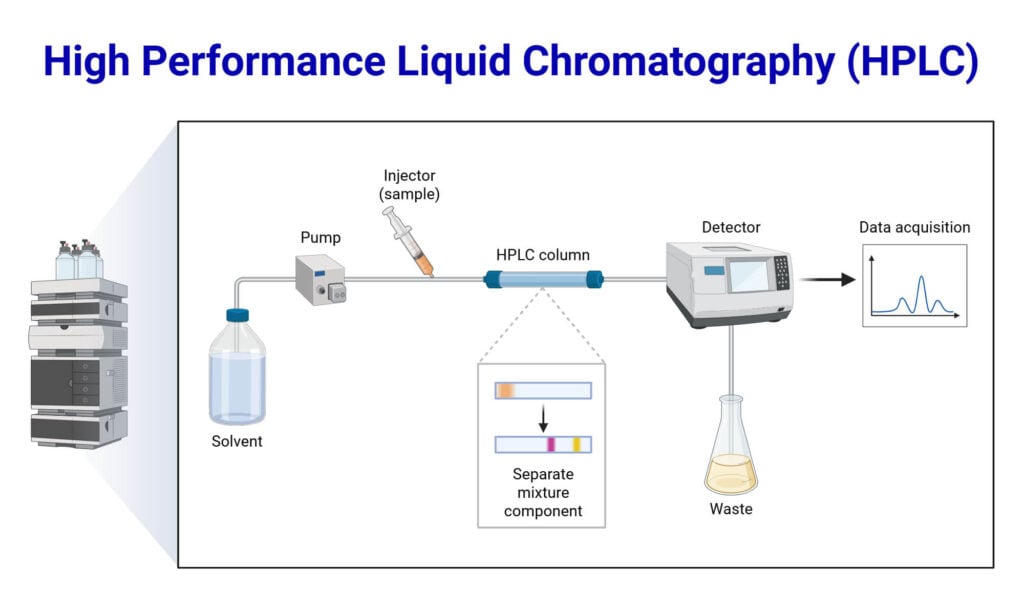
Key Components of an HPLC System
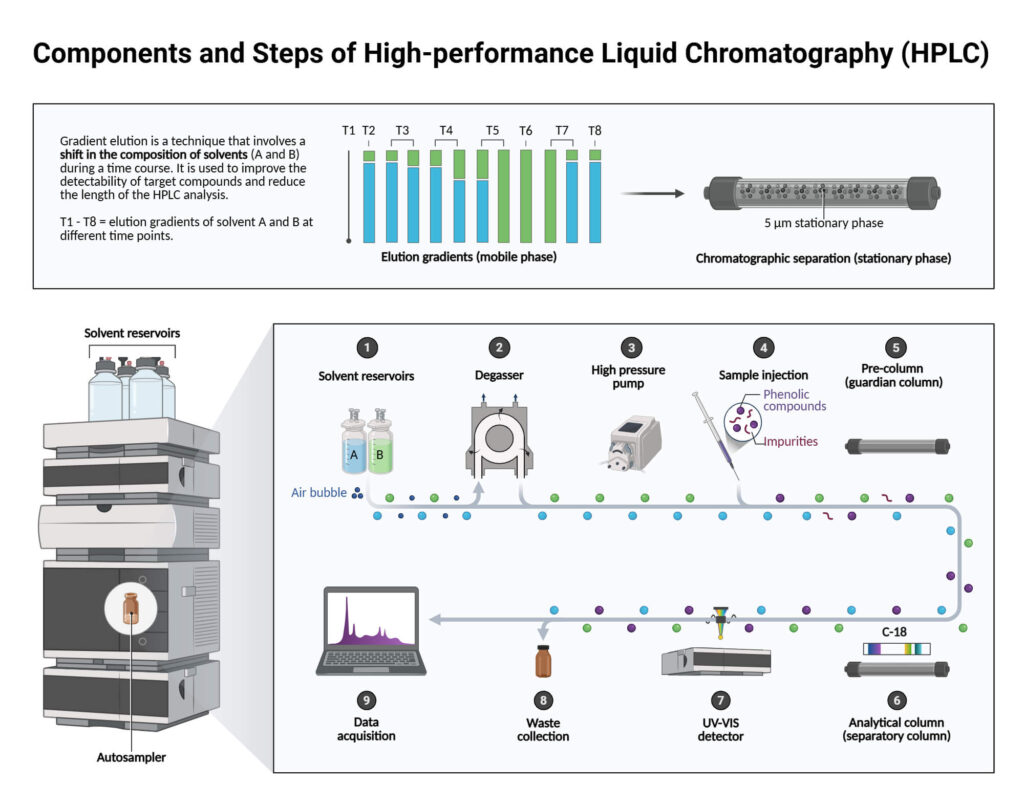
Solvent Reservoir: This container holds the mobile phase that will carry the sample through the instrument. It connects to the rest of the system via inlet tubing fitted with a filter, which keeps particles from the solvent out of the pump and column. Water, methanol, and acetonitrile are among the most commonly used solvents.
Pump: The pump maintains a steady, high-pressure flow of the mobile phase through the system. HPLC instruments may use isocratic pumps (single solvent) or binary/quaternary pumps (blending two or four solvents), and must be powerful enough to force liquid through a column packed with very fine particles.
Degasser: This component removes gases dissolved in the mobile phase, which is important because trapped air bubbles can cause unstable pressure, pump problems, and noisy detector signals.
Sample Injector: This device introduces a precisely measured volume of sample into the flowing mobile phase without disrupting the flow. Some systems use manual injectors, while high-throughput labs typically rely on automated autosamplers, which improve consistency, reduce hands-on work, and allow many samples to be processed one after another.
Column and Column Oven: The column is where separation actually takes place. It is filled with fine, adsorbent particles — often silica-based or polymer-based — housed in a stainless-steel casing strong enough to withstand high pressure. Guard columns and filters are commonly placed before the main column to trap debris and protect it from damage. Because temperature affects how well separation occurs and how long it takes, a column oven is used to keep the column at a consistent, controlled temperature throughout the run.
Detector: As compounds leave the column, the detector senses them and converts that response into an electrical signal for further analysis. Which detector is used depends on the sample and the goals of the analysis; common choices include UV-visible detectors, fluorescence detectors, refractive index detectors, evaporative light-scattering detectors, and mass spectrometers.
Data System: This is the software and hardware that runs the instrument, captures the detector’s output, and turns it into a chromatogram that can be used for both identifying and quantifying the sample’s components.
Categories of HPLC
HPLC methods are generally grouped according to how they achieve separation:
Normal-phase HPLC pairs a polar stationary phase (commonly silica) with a non-polar mobile phase, such as hexane or chloroform. Separation depends on polarity: more polar compounds cling to the stationary phase longer and take more time to elute.
Reverse-phase HPLC, the most widely used variant, flips this arrangement — a non-polar stationary phase (such as C18-bonded silica) paired with a polar mobile phase like water mixed with methanol or acetonitrile. Here, separation depends on hydrophobic interactions, so non-polar compounds are the ones retained longest.
Ion-exchange chromatography separates ions and charged molecules based on their electrical charge. The stationary phase is functionalized with charged groups that attract oppositely charged ions in the sample, and the method is divided into cation-exchange and anion-exchange types depending on which charge is targeted.
Size-exclusion chromatography sorts molecules by physical size rather than chemical interaction, making it useful for polymers and large biological molecules. When run with organic solvents it’s called gel permeation chromatography; with aqueous solvents, it’s called gel-filtration chromatography. Larger molecules pass around the stationary phase’s pores and elute quickly, while smaller molecules get temporarily trapped inside the pores and take longer to come out.
What Affects HPLC Performance
Several variables shape how well an HPLC separation performs:
Stationary phase properties — particle size and surface area affect resolution; smaller particles give better separation but increase back pressure on the system.
Mobile phase composition — gradient elution (changing solvent composition over the run) suits complex samples, while isocratic elution (constant composition) works fine for simpler ones.
Flow rate — faster flow shortens run time but can reduce resolution; slower flow improves resolution at the cost of a longer run, so a balance must be found.
Column temperature — higher temperatures can sharpen peaks and speed up the run by lowering solvent viscosity, but excessive heat risks damaging the sample or the column packing.
Injection volume — too much sample can overload the column and distort results, while too little can make detection less sensitive.
Applications of HPLC
HPLC is central to pharmaceutical development and quality control, where it’s used to assess drug stability and other properties to confirm that medications are safe and effective.
In environmental science, it helps detect and monitor pollutants, including pesticide residues and industrial contaminants.
The food industry relies on it for quality assurance, such as identifying additives and screening for contaminants.
Clinical laboratories use HPLC to analyze biological samples like blood, plasma, serum, and urine — supporting drug and metabolite quantification, therapeutic drug monitoring, and disease diagnosis.
In forensic science and toxicology, it’s used to screen for and confirm drugs of abuse, analyze biological fluids for toxicological evidence, and support doping control in sports and veterinary settings.
More broadly, industries across many sectors use HPLC for routine quality control and to monitor how stable their products remain over time.
Advantages of HPLC
High-performance liquid chromatography offers rapid, precise separation and identification of multiple compounds within a single mixture. Its high sensitivity makes it possible to detect even trace-level substances, and its versatility allows it to handle a broad range of sample types. Unlike gas chromatography, HPLC can process molecules that are non-volatile or break down under heat. The technique also lends itself well to automation, making it ideal for high-volume, routine testing, and it generally outpaces other chromatographic methods in speed. Mechanically, HPLC relies on pumps that force a pressurized liquid solvent through a column packed with absorbent material.
Limitations of HPLC
Running HPLC can be costly, since both the equipment and the reagents it requires come at a premium. Certain compounds — particularly volatile ones — are poorly suited to HPLC and are better handled through gas chromatography instead. Method development and troubleshooting can also be technically demanding, and configuring a run involves balancing multiple interacting variables such as flow rate, column choice, temperature, and mobile phase composition. On top of this, effective use of the technique typically demands well-trained personnel.
Conclusion
High-performance liquid chromatography is an analytical separation method widely applied across industries to identify substances within liquid samples. It works by using high pressure to push liquid solvents through columns filled with finely particulate absorbent material.
Since its emergence in the late 1960s, HPLC has become one of the most effective tools for separating small molecules and polymers. Its broad industrial use stems from its capacity to handle even intricate, multi-component mixtures and to pick out compounds present only in trace amounts. It further stands apart from gas chromatography in its ability to work with non-volatile substances.
 Nafeesa
Leave a comment