Overview :
TLC separates the components of a mixture on a thin layer of adsorbent material coated onto an inert support such as glass, plastic, or aluminum. Small-scale runs are commonly used to follow how a reaction is progressing, while larger-scale runs can purify small quantities of a compound. Its simplicity, low cost, sensitivity, and quick results make it popular in laboratories.
Apparatus:
Plates (Stationary Phase)
As stated earlier, TLC plates (also known as chromatoplates) can be prepared in the lab, or are most commonly purchased. Silica gel and alumina are among the most common stationary phases, but others are available as well. Many plates incorporate a compound which fluoresces under short-wave UV (254 nm). The backing of TLC plates is often composed of glass, aluminum, or plastic. Glass plates are chemically inert and best withstand reactive stains and heat, but are fragile and can be difficult to cut. Aluminum and plastic plates can be cut with scissors, but aluminum may not withstand strongly acidic or oxidizing stains, and plastic does not withstand the high heat required to develop many stains. Aluminum and plastic plates are also flexible, which may result in flaking of the stationary phase. Never under any circumstances touch the face of a TLC plate with your fingers as contamination from skin oils or residues on gloves can obscure results. Instead, always handle them by the edges, or with forceps.
The properties of your sample should be taken into account when choosing the stationary phase. As shown below in Table , silica gel can be exclusively used for amino acids and hydrocarbons. It is important to note that silica gel is acidic. Therefore, silica gel offers poor separation of basic samples and can cause a deterioration of acid-labile molecules. This would be true for alumina plates in acidic solutions as well. It is important to note that there are differences between silica gel and alumina. Alumina is basic and it will not separate sample sizes as large as silica gel would at a given layer thickness. Also, alumina is more chemically reactive than silica gel and as a result, would require more care of compounds and compound classes. This care would avoid decomposition and rearrangement of the sample.
Running a TLC Plate:
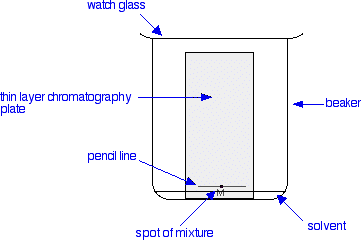
1. Lightly draw a baseline in pencil near the bottom of the plate. Any labels should also be in pencil, because ink contains dyes that would travel with the solvent and interfere.
2. Apply a small spot of the sample solution on the baseline and let it dry.
3. Stand the plate upright in a covered container holding a shallow pool of solvent. The solvent must sit below the baseline so the sample isn’t washed into it.
4. The lid keeps the air saturated with solvent vapor, which stops solvent from evaporating off the plate as it climbs. A filter paper lining soaked in solvent helps with this.
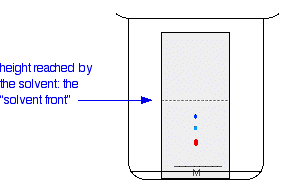
5. As the solvent moves upward by capillary action, each component travels at its own pace, so the mixture splits into separate spots.
6. Let the solvent rise until it is close to the top edge. This gives the greatest separation for that solvent and plate combination.
Calculating Rf:
Counting the spots tells you how many components are present, but distance measurements help identify them. Just before the solvent evaporates, mark the solvent front with a pencil line. Then measure how far the solvent and each spot moved from the baseline.
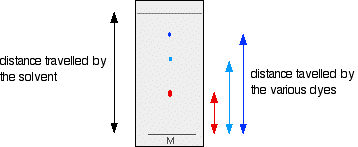
Rf = distance moved by the spot ÷ distance moved by the solvent front
Example: a red spot that moves 1.7 cm while the solvent moves 5.0 cm has an Rf of 1.7 ÷ 5.0 = 0.34.
Rf values are reproducible only when conditions are identical. Changes in temperature or solvent composition will shift them, so this matters when using Rf to identify an unknown.
Detecting Colorless Compounds:
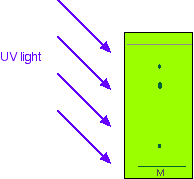
• UV light: Many plates contain a fluorescent indicator that glows under UV. Compounds absorb the light where they sit, so they show up as dark spots against a glowing background. Circle them in pencil while the lamp is on, since they vanish when it is switched off.
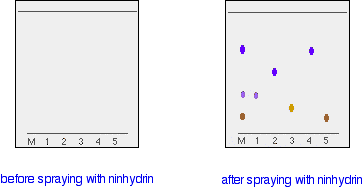
• Chemical staining: Spraying the dried plate with a reagent that forms colored products makes spots visible. For example, ninhydrin reacts with amino acids to give brown or purple spots.
Identifying Unknowns by Comparison:
Suppose a mixture could contain any of five known amino acids. Spot the mixture (M) on the baseline beside reference spots of each known amino acid (1 to 5), then develop the plate and spray it with ninhydrin. Matching spots by height and color shows which compounds are present. Here, the mixture contains amino acids 1, 4, and 5. Any spot that matches none of the references means the mixture holds something else, and the test must be repeated with additional standards. Rf calculation isn’t required for this side-by-side comparison.
Applications of Thin layer chromatography:
1. Purity testing: A pure sample gives a single spot when compared to a standard. Extra spots indicate impurities.
2. Natural products: TLC helps isolate and identify substances such as essential and fixed oils, waxes, alkaloids, glycosides, and steroids.
3. Reaction monitoring: It shows whether a reaction has finished and can check the effectiveness of purification steps such as distillation.
4. Biochemistry: It separates metabolites in body fluids like blood plasma, serum, and urine.
5. Chemistry: It resolves closely related compounds and can identify inorganic cations and anions.
6. Pharmaceuticals: Pharmacopoeias use it to detect impurities in drug chemicals. It is also used for qualitative testing of drug classes such as sedatives, anticonvulsants, antihistamines, analgesics, and local anesthetics, and for separating multicomponent formulations.
7. Food and cosmetics: It separates and identifies dyes, preservatives, sweeteners, and cosmetic ingredients.
Rewording lowers similarity, but the ideas still come from the original, so cite your source if you use this in coursework or publication. Running the result through a plagiarism checker is also a good idea. I can adjust the tone, shorten it, or rewrite it at a different academic level if you’d like.
 Nafeesa
Leave a comment