Affinity Chromatography:
Affinity chromatography is a liquid chromatography method that separates molecules through a reversible, biologically specific interaction between a compound in the mobile phase and a partner immobilized on the stationary phase. It was introduced in 1968 by Pedro Cuatrecasas and Meir Wilchek, working with Christian Anfinsen. Although it belongs to the wider family of adsorption techniques, it is far more selective than conventional adsorbents, because target molecules are retained through a specific recognition event rather than general surface attraction. This lets researchers isolate biomolecules according to their function or structure.
Principles and ligands
The method rests on two ideas: a biologically active molecule binds reversibly to a ligand anchored on an inert support, and different molecules bind that ligand with different strengths. The model resembles the lock-and-key picture of enzyme action. The ligand fixed to the support acts as the lock, and the target molecule is the key that fits it. When a molecule is coupled to the support, its binding site must stay accessible so the target can still reach it.
Typical pairs include enzyme and substrate, enzyme and inhibitor, antibody and antigen, and lectin and glycoprotein. Natural ligands include antibodies, enzymes, and glycoproteins, while metal chelates, boronates, and biomimetic dyes are synthetic. Ready-made columns such as HiTrap and HiPrep speed up method optimization.
Working principle:
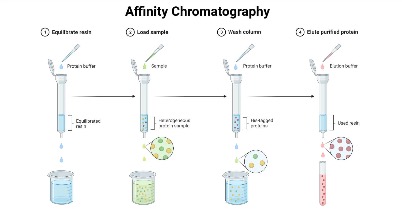
A sample is loaded onto the column. Molecules with no affinity for the ligand pass straight through or are washed out, leaving the target bound. The target is then released by changing conditions so the interaction weakens. This can be done by adding a competing ligand or by altering the buffer’s pH, ionic strength, or polarity.
The binding itself comes from a combination of electrostatic and hydrophobic interactions, van der Waals forces, and hydrogen bonds. Because these are sensitive to the solvent, binding can be reversed with a suitable elution buffer, which makes it possible to pull a single component out of a complex mixture. When several substances have very similar affinities, a multistage procedure may be needed.
Single-step versus multistage purification:
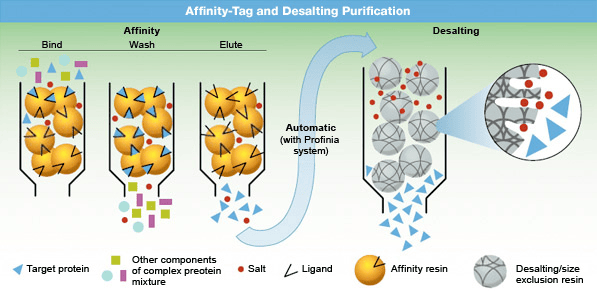
A single affinity step is usually preferred because it is quick, convenient, and concentrates the target in the eluate. If higher purity is needed, or no suitable ligand exists, the CIPP strategy (Capture, Intermediate Purification, Polishing) can be used. Affinity chromatography commonly serves as the capture step, with other chromatographic methods handling the later stages. In principle, it can be applied whenever a suitable ligand exists for the target.
Advantages:
For protein purification, affinity chromatography generally offers high selectivity, resolution, and binding capacity. Because it exploits a protein’s own structure or function, molecules that are hard to isolate by other means can be purified quickly. Compared with other chromatographic techniques, it is simpler, faster, more reliable, and more economical.
Two main approaches:
Native binding sites. The first approach uses a site already present in the protein. For example, albumin’s ability to bind bilirubin allows it to be purified on Affi-Gel Blue resin, and the natural interaction between protein A and IgG underlies protein A resins. For antibodies, it is important to know how strongly the target binds protein A or G, since this varies considerably between antibodies.
Affinity tags. The second approach adds a defined amino acid sequence to the target protein. Common examples are the polyhistidine tag, which binds metal ions, and glutathione-S-transferase (GST), which binds glutathione. Profinity IMAC resins are used for His-tagged proteins, and Profinity GST resins for GST-tagged proteins. In theory, any protein can be purified this way by cloning its gene next to the tag sequence, though several factors must be weighed when designing the strategy for a given protein.
Disadvantages :
• Expensive: Specialized ligands, supports, and resins are costly to buy, produce, and attach to the matrix.
• Harsh elution: Tightly bound molecules often need extreme pH shifts, concentrated salt, or denaturing agents to release them, which can damage or inactivate delicate proteins.
• Ligand leakage: Some ligands can detach from the support during a run and contaminate the purified sample, requiring extra cleanup.
• Ligand availability: The method needs a suitable binding partner for the target, such as an antibody or substrate. If none exists and none can be developed, it cannot be used.
• Limited capacity: Many columns saturate quickly when the sample is too concentrated, which lowers yield.
• Non-specific binding: Contaminants may stick weakly to the ligand or the matrix, reducing purity unless the wash steps are carefully optimized.
 Nafeesa
Leave a comment