The Cycle of Socialization
Dr. Bobbie Harro developed this framework in 2000, and though she retired from Springfield College’s Education Department in 2014, her model remains widely used today. The Cycle of Socialization offers a way to understand how people absorb and internalize systems of oppression and privilege over the course of their lives. For full context, the original source material is worth reading directly; what follows is a condensed overview.
The cycle begins at birth, before any prejudice or bias has taken root. Early on, we pick up the basics of our culture from the people closest to us — parents, siblings, extended family, and caregivers. As we grow, broader institutions take over: schools, media, religious communities, sports, and more shape our worldview further. These lessons get reinforced through a system of rewards and consequences, which eventually produces certain advantages for some and disadvantages for others. By the end of the process, society ends up unequal — many people who are disadvantaged come to accept their circumstances, while those with more power come to see their advantages as normal or deserved.
What makes this cycle persistent is that it renews itself: it keeps marginalized groups in a subordinate position while protecting those already in power, often by discouraging anyone who challenges the existing order. Still, the final stage of the cycle isn’t a dead end — it’s a fork in the road. At that point, a person can either accept things as they are or actively work to change them. That choice belongs to each of us: keep the pattern going, or become someone who helps break it.
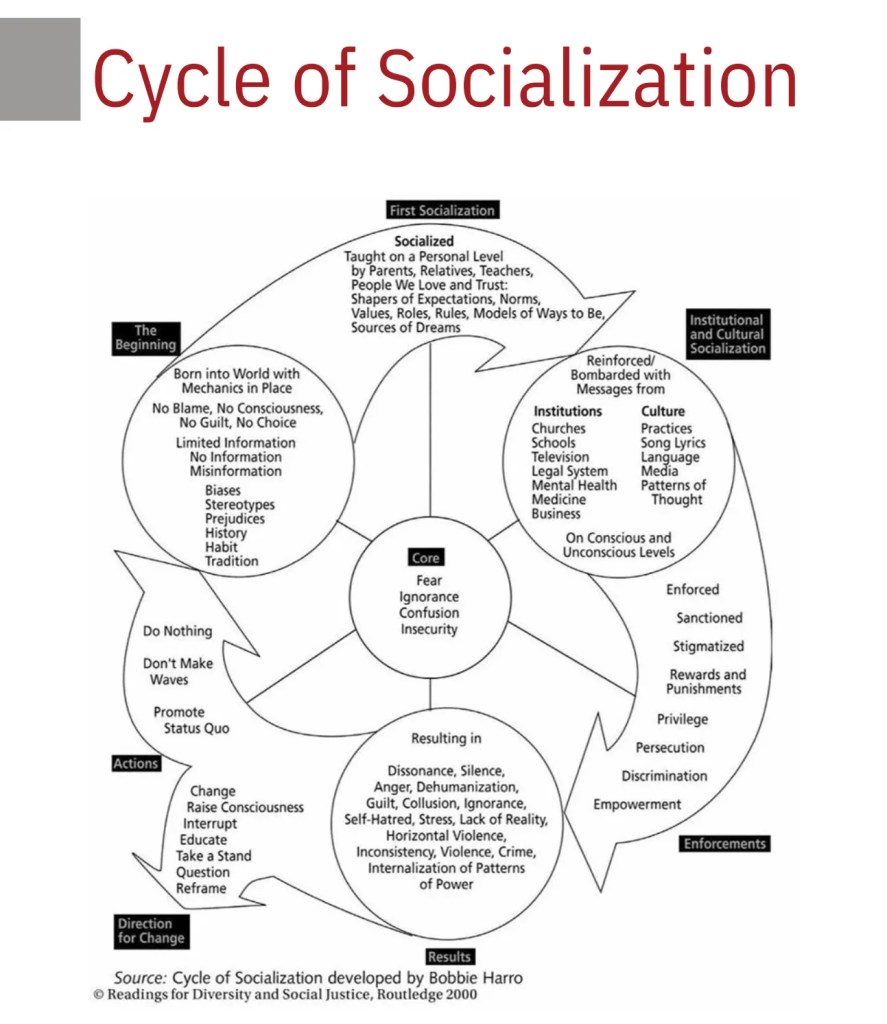
Where Do We Fit in Our Kids’ Cycle of Socialization?
But that crossroad is not the only place we can break the Cycle of Socialization. As parents, teachers, and caregivers we can definitely encourage our kids to take action in that latter part of the cycle, but we can also interject at every point of the cycle. Of course, where you start depends on how old your kids are right now, but most of this can apply at any age. (Sidenote: The amazing book Rainbow Parenting is basically an instruction manual for interrupting the cycle at these various points.)
We have the most influence at the stage of first socialization. This doesn’t just mean being aware of the messages we as parents teach our children, but also looking at who else is in a position to give them those early messages. Babies and toddlers pick up everything, no matter how subtle. Everyone in that early bubble is giving your child their first socialization, the foundation for all other socialization. So vet them carefully.
Institutional and cultural socialization is less under our control, but we can still direct it, especially in kids’ younger years. It can feel like a full-time job finding books, TV, movies, schools, etc, that don’t teach our kids bias, but every bit can help. As much as we try to prevent negative external socialization, it will happen because we can’t avoid all media and all people. So we should also teach kids to think critically of all influences in their lives, even our own, since we hold biases too.
Having influence over the enforcements stage is certainly the most challenging as parents, but also the most important. We must teach kids pride in their oppressed identities and humility in their oppressor identities. It’s critical to empower kids to look beyond the enforcements they’ll inevitably face. For example, we can’t change that society gives our kids unearned privilege in certain areas, but we can teach our kids to use that privilege to change the system rather than using it to oppress. And we can teach them to ignore or push back against any punishments society might direct at them for stepping outside of the cycle.
But we also need to do this work ourselves while doing it for kids. Before we can be effective leaders in breaking free from the cycle, we need to break free ourselves. Going back to the bread, you wouldn’t try to teach your kid to bake a loaf of sourdough before learning to do it yourself first, would you? (OK, I bet some would. But how’s that bread going to turn out?) This doesn’t mean we can’t start working with our kids now, as we’re on our own journeys. We must recognize that we’ll never do this perfectly and will always be learning.
1. Where It Starts
From the moment we’re born, we begin absorbing the expectations and norms of the society around us — along with learning how that society rewards conformity and punishes anyone who steps outside the lines. This early stage is charged with emotion: fear, uncertainty, and a lack of understanding all play a role in how we come to view the world and the people in it.
2. Early Influences
Parents and close family are usually the first teachers, passing along social norms simply through everyday behavior and interaction.
For instance, a child who notices a parent lock the car doors while driving through a certain part of town may come away with an unfounded sense that the area — and the people who live there — are dangerous.
3. Broader Social Institutions
As we grow, we’re exposed to a much wider set of influences — schools, media, and religious institutions among them — each carrying its own expectations and consequences for stepping outside them.
For example, a classroom lesson that frames European colonizers as heroic explorers while portraying Indigenous peoples as lesser can leave one group feeling superior and the other marginalized.
4. Reinforcement
Society consistently rewards conformity to its norms and penalizes departure from them.
Consider someone raised to believe that success means fierce individual competition — they may struggle to advance at work once they realize the environment actually values collaboration.
5. The Fallout
People can experience real internal conflict as a result — anything from quiet unease to open anger or resigned acceptance — depending on their personal experiences and how they process them. Fear, confusion, and insecurity often sit underneath these reactions.
For example, a young woman drawn to engineering might be steered away from it by the lingering assumption that men are naturally better suited to technical fields.
6. What Comes Next
At this stage, people face a choice: keep going along with the existing system, or start pushing back against it in ways big or small.
Someone who sees the toll that a hyper-competitive workplace takes on their colleagues, for instance, might begin advocating for a more cooperative culture instead.
7. Emotion as the Engine
The entire cycle runs on emotion. Fear, confusion, and insecurity are what make us go along with social expectations in the first place, and those same feelings are what give rise to bias and discrimination down the line. Recognizing this emotional foundation is essential to interrupting the pattern.
8. Interrupting the Pattern
The real turning point comes at the end of the cycle, where each of us has to decide whether to keep reinforcing an unjust system or actively resist it.
Staying With What’s Familiar
Many people, consciously or not, choose to go along with things as they are — often because doing so is simply easier than pushing against an entrenched system. This choice, even if passive, allows existing inequities to persist.
Choosing to Push Back
Choosing liberation means actively withdrawing support from a system that benefits some at the expense of others. Making that choice requires…


Leave a comment